For many manufacturers, the decision to move from Microsoft Dynamics GP to Microsoft Dynamics 365 Business Central feels like the beginning of an ERP project.
In my experience, it is not.
The real work starts well before anyone configures Business Central, migrates a database, or trains a user. It starts when the leadership team clarifies why the organization is modernizing, what needs to change, what needs to stay, and how the business will prepare for the transition.
That distinction matters because a successful Dynamics GP migration plan is not primarily a technology plan. It is a business plan.
I have seen manufacturers approach ERP modernization from both directions. Some start with software demonstrations, feature lists, and implementation timelines. Others first examine their business objectives, processes, data, organizational readiness, and operational risks.
The second group usually enters implementation with much greater clarity.
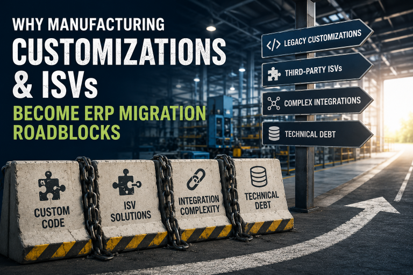
If you have followed our previous discussions about [why manufacturers using Dynamics GP are hesitant to move to Business Central], [whether Business Central can really handle manufacturing complexity], [the real fear behind leaving Dynamics GP in manufacturing], and [why manufacturing customizations and ISVs become ERP migration roadblocks], you will recognize a common theme: the technology is only one part of the decision.
Once the decision to modernize is made, planning is the most important next step.
Table of Contents
Why Does ERP Modernization Planning Matter?
What Are the Seven Stages of Successful ERP Planning?
Why Does Manufacturing Require More ERP Planning?
What Planning Mistakes Should Manufacturers Avoid?
What Does ERP Readiness Look Like in Practice?
What Should Executives Confirm Before Implementation?
Executive Takeaways
Frequently Asked Questions
Final Thoughts
“A successful Dynamics GP migration plan isn’t primarily a technology plan. It’s a business plan.” — Andrew Good, CEO, Liberty Grove Software
Why Does ERP Modernization Planning Matter?
When leadership teams talk about a Business Central migration, the conversation can quickly become technical.
Which data will migrate? Which integrations need to be rebuilt? Which extensions will be required? How long will implementation take?
Those are important questions. They are not the first questions.
The first questions should be business questions.
What are we trying to improve?
Where is Dynamics GP limiting the organization today?
Which processes create unnecessary effort or risk?
What capabilities will the business need in three to five years?
How will we know this modernization has been successful?
These questions turn ERP modernization planning into a strategic exercise rather than a software replacement project.
Microsoft’s own guidance for organizations preparing a Dynamics GP cloud migration recommends assessing migration readiness, determining what data should migrate, choosing a migration approach, and carefully planning the schedule before the production transition.
That technical preparation is important. For a manufacturer, however, the business preparation surrounding it is equally important.
Your ERP touches finance, purchasing, inventory, production, warehousing, sales, costing, planning, and often the shop floor. A decision made in one area can have consequences throughout the organization.
That is why I tell executives that ERP governance needs to begin before implementation.
You want agreement on objectives, decision-making authority, project ownership, priorities, and acceptable tradeoffs while you still have time to think carefully about them.
What Are the Seven Stages of Successful ERP Planning?
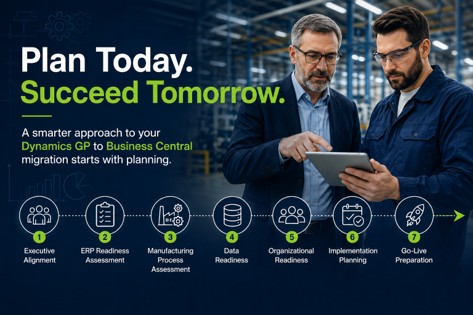
A good ERP migration strategy should move through a deliberate sequence. I generally think of successful planning in seven stages.
1. Executive Alignment
Start with leadership.
The CEO, CFO, COO, CIO, and other executive sponsors do not need to become Business Central experts. They do need to agree on why the company is undertaking the project.
Is the goal to support growth? Improve operational visibility? Reduce dependence on manual processes? Modernize infrastructure? Standardize processes across locations? Improve reporting? Create a stronger foundation for future digital capabilities?
There can be several objectives, but team leadership should prioritize them prior to implementation.
Without executive alignment, project teams are forced to make strategic decisions during implementation. That is where delays, scope disagreements, and expensive rework begin.
2. ERP Readiness Assessment
Next, assess the current environment honestly.
An ERP readiness assessment should look beyond whether Dynamics GP can technically be migrated.
Evaluate your current architecture, integrations, customizations, ISVs, reporting, data, security requirements, business processes, and user dependencies.
Ask which capabilities are essential and which exist because “that is how we have always done it.”
This is also where manufacturers should identify hidden dependencies. A spreadsheet maintained by one employee or an old integration that nobody discusses may be more operationally important than a highly visible customization.
Readiness means understanding those realities before they catch the project team by surprise.
3. Manufacturing Process Assessment
Do not assume every existing process should be recreated in BC.
One of the biggest opportunities in a manufacturing ERP migration is the chance to ask whether today’s processes still make sense.
Map how work actually happens across quoting, order entry, purchasing, planning, production, inventory, warehousing, shipping, costing, and financial reporting.
Pay particular attention to workarounds.
If employees routinely export data to Excel, rekey information between systems, maintain shadow databases, or rely on tribal knowledge, those behaviors tell you something important about the current environment.
Business Central supports manufacturing capabilities involving production BOMs, routings, work and machine centers, capacity and costs, production orders, supply planning, inventory, warehousing, and related processes.
The planning question is not simply, “Can BC do this?”
It is, “How should our business operate in the future?”
4. Data Readiness
Data is often treated as an implementation task. I believe it belongs in planning.
Your customer records, vendor records, items, bills of material, routings, inventory, costing information, and financial data all influence the quality of the new environment.
If the source data contains duplicates, obsolete records, inconsistent naming conventions, or years of accumulated workarounds, moving everything does not solve the problem. It relocates it.
Decide early which data has business value, which requires cleansing, which should be archived, and who owns each data domain.
This topic deserves much more attention, which is why the next article in this series will focus specifically on what data manufacturers should migrate from Dynamics GP to Business Central.
5. Organizational Readiness
ERP modernization changes how people work.
That makes change management a planning responsibility, not something to add a few weeks before go-live.
Identify the people whose jobs and workflows will change. Bring process owners into the project early. Understand where resistance is likely to emerge and, more importantly, why.
Often, resistance is not really about the new ERP. People may be concerned about losing a familiar process, giving up a trusted workaround, or being asked to adopt a new workflow without understanding the reason for it.
Good communication addresses those concerns early.
6. Implementation Planning
Only after the earlier stages are understood should you build the detailed Business Central implementation plan.
Define scope, phases, resources, responsibilities, testing expectations, training requirements, integration work, data migration activities, decision processes, and escalation paths.
For a manufacturing ERP implementation, I also recommend looking carefully at business timing.
When are your busiest production periods? When is inventory count? Are there major customer commitments, plant shutdowns, acquisitions, audits, or other initiatives competing for the same people?
An ERP project consumes organizational capacity. Plan accordingly.
7. Go-Live Preparation
Go-live planning should begin well before go-live week.
Define what must be true before the business switches systems.
Have critical processes been tested end-to-end?
Have users been trained?
Has the data been validated?
Have integrations been tested under realistic conditions?
Does everyone understand cutover responsibilities?
Is there a support and escalation plan?
What happens if an issue affects shipping, production, inventory, or invoicing?
A good go-live plan reduces uncertainty because people know what will happen, who owns each activity, and how decisions will be made.
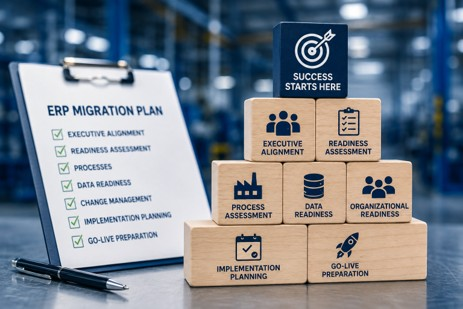
Successful ERP modernization starts with alignment, readiness, and disciplined planning.
Why Does Manufacturing Require More ERP Planning?
Manufacturing is interconnected in ways that can make ERP modernization particularly demanding.
Consider a seemingly simple customer order.
It can affect demand planning, purchasing, material availability, scheduling, production orders, labor and machine capacity, inventory, warehouse activity, shipping, costing, invoicing, and financial reporting.
Now add multiple facilities, subcontracting, complex BOMs, routings, lot or serial tracking, specialized costing requirements, warehouse systems, MES integrations, and years of custom Dynamics GP processes.
That is why manufacturing companies should resist generic implementation thinking.
Microsoft describes production orders as a central component of Business Central manufacturing, using information from items, production BOMs, routings, machine centers, and work centers to help manufacturers plan and control production.
Those connections are exactly why preparation matters.
A decision about item setup may affect planning. A routing decision may affect scheduling and capacity. A warehouse process may affect production consumption. A costing decision may ultimately affect financial reporting.
The more connected your operation, the more valuable disciplined planning becomes.
What Planning Mistakes Should Manufacturers Avoid?
There are several patterns I see repeatedly.
Starting with software demonstrations. Demos are useful, but they should answer business questions rather than define them.
Ignoring current business processes. If you do not understand how work gets done today, it is difficult to design a better future state.
Underestimating change management. A technically successful system that employees do not adopt is not a successful modernization.
Treating ERP as an IT project. IT is essential, but ERP touches the business’s operating model. Operations, finance, supply chain, manufacturing, and executive leadership all need ownership.
Weak executive sponsorship. Leadership cannot disappear after the budget is approved. Projects need timely decisions, priority setting, conflict resolution, and visible support.
There is a simple pattern underlying all five mistakes: organizations begin implementation before they are ready.
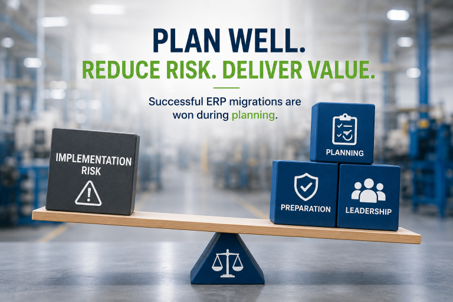
ERP risk is reduced long before go-live through disciplined planning, organizational preparation, and strong executive leadership.
What Does ERP Readiness Look Like in Practice?
Here is a composite example based on a pattern I have encountered in manufacturing assessments.
A manufacturer believes it is ready to move from Dynamics GP to BC. Leadership has discussed the need for modernization, employees are frustrated with reporting, and the company wants to reduce reliance on aging customizations.
At first, the project looks straightforward.
Then the assessment begins.
Production relies on several spreadsheets that are not formally documented. Purchasing uses a workaround created years ago for a business requirement that has since changed. Finance depends on custom reports built around historical account structures. An integration that everyone assumed was minor turns out to be critical to daily warehouse operations.
None of these discoveries mean the company should not modernize.
They mean the company now knows what it is actually modernizing.
That knowledge changes the project.
The team can decide which processes should be redesigned, which integrations should remain, which data requires cleanup, which users should participate in testing, and where change management will matter most.
The assessment did not create complexity. It exposed complexity while there was still time to manage it.
That is exactly what good ERP modernization planning should do.
“The assessment didn’t create complexity. It exposed complexity while there was still time to manage it.” — Andrew Good
What Should Executives Confirm Before Implementation?
Before approving the start of implementation, I recommend that executive teams be able to answer “yes” to most of the following:
- Do we have clearly defined business objectives for modernization?
- Is the executive team aligned on priorities and expected outcomes?
- Have we completed an ERP readiness assessment?
- Do we understand our current manufacturing processes and major workarounds?
- Have we identified critical Dynamics GP customizations, ISVs, and integrations?
- Do we know which processes should be changed rather than recreated?
- Have we established ownership for data cleansing and migration decisions?
- Have we identified process owners and key users?
- Is there a clear ERP governance and decision-making structure?
- Have we planned for change management and user adoption?
- Does the implementation schedule reflect production and business realities?
- Have we defined testing, training, cutover, and go-live readiness criteria?
- Do we know how leadership will measure the success of the project after implementation?
If several answers are “no,” that does not mean the project has failed.
It means you have identified where to focus before implementation begins.
That is valuable information.
Executive Takeaways
For CEOs, CFOs, COOs, CIOs, and manufacturing leaders considering a move from Dynamics GP to Business Central, I would leave you with five points.
First, treat ERP modernization as a business initiative. Technology enables the change, but business outcomes should drive it.
Second, invest in readiness before configuration. Understanding processes, data, integrations, people, and risks early is far less disruptive than discovering them halfway through implementation.
Third, establish executive alignment and ERP governance early. Someone needs to own priorities, decisions, and outcomes.
Fourth, use modernization to improve rather than automatically replicate. Moving every old process and workaround into a new ERP can preserve the very limitations you are trying to escape.
Fifth, remember that planning reduces uncertainty. Preparation reduces risk. Leadership determines success.
“Planning reduces uncertainty. Preparation reduces risk. Leadership determines success.” — Andrew Good
A strong Dynamics GP migration plan does not guarantee that an implementation will never encounter a surprise. Manufacturing is too complex for that.
It does make the organization much better prepared to respond to surprises.
Before You Start Your Migration, Make Sure You’re Ready
Moving from Dynamics GP to Business Central is a significant decision. But the biggest risks often are not found in the software. They are hiding in your processes, data, integrations, customizations, and assumptions about how the business actually operates.
Finding those issues during implementation can be expensive and disruptive. Finding them before implementation gives you options.
That is exactly why we recommend starting with a Manufacturing ERP Readiness Assessment.
At Liberty Grove Software, we help manufacturing leadership teams take an objective look at where they are today, identify potential migration risks and dependencies, and establish the priorities that should shape a successful Dynamics GP migration plan.
The goal is not to rush you into an implementation. It is to give your team the clarity and confidence to make the right decisions before one begins.
If you are considering a move from Dynamics GP to Business Central, talk with our team about a Manufacturing ERP Readiness Assessment. Let’s make sure your organization is ready before the implementation clock starts.
Frequently Asked Questions
How do manufacturers start planning a Dynamics GP migration?
Start with business objectives and an ERP readiness assessment rather than software configuration. Establish why the company is modernizing, identify executive sponsors, assess current processes and technology dependencies, evaluate data readiness, and define the future-state priorities that will guide the migration.
What should be included in an ERP migration plan?
An ERP migration strategy should cover executive alignment, governance, current and future business processes, data readiness, integrations and customizations, organizational change, implementation scope, resources, testing, training, cutover, go-live support, and measures of success.
What is an ERP readiness assessment?
An ERP readiness assessment evaluates how prepared an organization is for modernization. For manufacturers, the examination should cover business processes, Dynamics GP configuration, customizations, ISVs, integrations, data quality, reporting, manufacturing requirements, organizational readiness, and project governance.
Who should be involved in ERP migration planning?
ERP planning should include executive sponsors and leaders from finance, operations, manufacturing, supply chain, IT, warehousing, and other functions affected by the system. Process owners and experienced frontline users should also participate because they understand how work actually happens.
Why do ERP implementations fail?
There is rarely one cause. Common contributors include unclear objectives, weak executive sponsorship, poor governance, insufficient process discovery, underestimated data issues, inadequate testing, limited user involvement, and weak change management. Many implementation problems can be traced to decisions that leadership should have addressed during planning.
How can manufacturers reduce ERP migration risk?
Reduce risk by assessing the current environment early, documenting critical processes and dependencies, cleaning data, defining governance, involving business users, testing realistic scenarios, preparing employees for change, and establishing clear go-live criteria.
Why is executive sponsorship important in ERP modernization?
ERP projects create cross-functional decisions and competing priorities. Executive sponsors provide direction, remove roadblocks, resolve conflicts, reinforce accountability, and keep the organization focused on business outcomes rather than departmental preferences.
What should manufacturers do before a Business Central implementation?
Before implementing Business Central, manufacturers should align leadership, complete an ERP readiness assessment, document current processes, define future-state requirements, evaluate customizations and integrations, assess data, establish governance, identify project resources, and develop plans for change, testing, training, and go-live.
Final Thoughts
I have spent enough time around manufacturing ERP projects to know that implementation gets most of the attention.
Planning deserves more.
The best time to discover that a process is poorly understood is before configuration. The best time to identify bad data is before migration. The best time to resolve conflicting priorities is before they affect the project schedule. And the best time to prepare employees for change is long before go-live.
Successful manufacturing digital transformation does not begin when the new ERP is switched on.
It begins when leadership decides to understand the business it has today and deliberately design the business it wants tomorrow.
If your organization is considering a move from Dynamics GP to Microsoft Dynamics 365 Business Central, a Manufacturing ERP Readiness Assessment can help identify the processes, data, technology dependencies, organizational considerations, and planning priorities to address before implementation begins.
In the next article in this series, I will take a closer look at one of the most consequential parts of that preparation: What Data Should Manufacturers Migrate to Business Central?
We will discuss why “migrate everything” is rarely the best strategy, which manufacturing data typically matters most, what may be better left behind, and how better data decisions can simplify your migration while creating a stronger foundation for BC.
About Andrew Good

Andrew Good, CEO, Liberty Grove Software
Andrew Good, CEO of Liberty Grove Software, a leader in digital transformation, directs the company with strategic insights that deliver impactful results. With over two decades of expertise in Microsoft technologies, Andrew has guided businesses through digital transformation across manufacturing, finance, and healthcare.
Andrew’s extensive knowledge comes from personal experiences with various companies. His hands-on operational knowledge comes from Engineering, Maintenance, and operational roles at Unilever and Sony Music. Fourteen years of working with Microsoft Dynamics BC/NAV follows successful projects in ERP, Computerized Maintenance Management Systems (EAM), and quality systems.
His passion for technology is matched by his love for sailing, which inspires his leadership. Andrew parallels the precision of navigating the seas and the challenges of steering a successful company. Under his leadership, Liberty Grove Software thrives, offering tailored solutions to empower clients and optimize operations with innovative Microsoft-based systems.